
AI Ethics, Poetry and the Woman Doing Both
No hype. No doom. Just an honest look at AI's ethics, its blind spots, and what it means for how we work. Olivia Heslinga breaks it down, one myth at a time.
By: Nicole Turcească
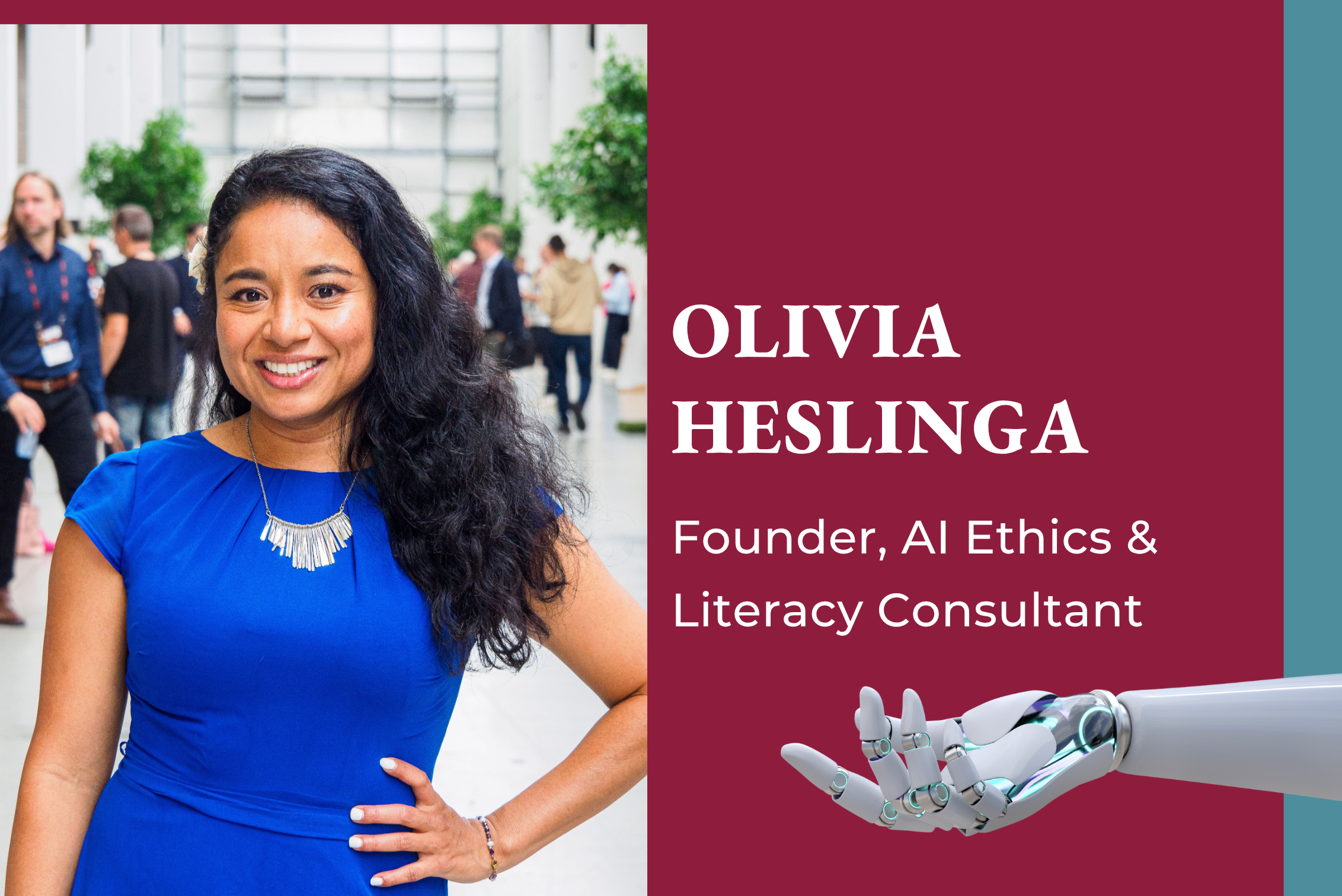
Let’s be honest, we’ve all probably hit our AI content limit for the year (it’s been THE subject in tech for years, after all). But, before you virtually walk away thinking this is just another “AI will save us all” piece, know this: Olivia Heslinga isn’t selling optimism or doom. She’s an AI Ethics & Literacy Consultant, keynote speaker, poet and founder of AI for Good Denmark, and her whole career is built on sitting in the uncomfortable (but exciting!) middle. She’ll tell you what’s genuinely useful about AI. She’ll also tell you exactly where it’s failing us, and who’s paying the price for that failure.
Getting to Know Olivia:
Olivia has always been drawn to SaaS and technology. AI felt like the next big thing, so she taught herself the fundamentals and let her curiosity lead. She learned what makes AI useful, and also what makes it problematic.
Conferences, in academia and in industry, showed her a gap. Few people were talking about politics, ethics and democratic oversight. She wants AI to serve the collective good, with transparent intentions and business practices, because those choices will soon shape our society.
As she grew into her work as an AI literacy and ethics advisor and public speaker, she needed one place to keep the research behind her talks. That became AI for Good Denmark. It began as a personal consultancy project. Today it is a global library of the initiatives she follows, the think tanks she has contributed to, and research on AI's limits and social impact, the kind the marketing hype tends to skip.
Away from work, one of her favorite books is Brave New World by Aldous Huxley. She finds it very relevant today, and it feeds her curiosity. What excites her most about AI is the chance to reimagine our social, political and technological structures, and to rebuild what no longer works.
Her current project is Teachsomebody.com, a collective learning platform. It puts ethical tech, change makers and local context at the center of AI narratives. It also brings in voices from the global south and the hidden labor behind AI. Local experts share their work on YouTube, Spotify and LinkedIn.
To keep up with her, look out for more articles on Dataethics.eu in the coming months. On LinkedIn, she shares what she is working on and which events she will attend.
If she were not doing this work, she would write more, poetry especially, and learn new creative skills to bring more beauty and human expression into the world.
AI ethics starts with a question about values
What it looks like day to day
Olivia sees AI ethics as a way for an organization to look at its own values. What does the company say it stands for? Are people empowered to live that out? The answers show up in work processes, in culture and norms, and in how behaviour gets watched and rewarded.
When AI is done well, teams share knowledge, work together and see how decisions get made. When it goes wrong, people end up bending their workflows around the tool. Knowledge sharing dries up and workers lose agency. Nobody has a plan for protecting digital assets either.
Keeping AI aligned is hard because it needs many kinds of expertise at once. Data management and data hygiene. Machine learning analysis and model drift. Reinforcement learning. Human evaluation and oversight. Ontology work. Teaching both people and AI what the company knows. Deciding what data means and when it should be used. Regulatory reporting sits on top of all of it. In Olivia’s view, this pushes companies to become learning organizations, with real investment in upskilling.
Most are not there yet. Many are rushing to adopt AI without strategic goals that fit their people and processes. Some are already running AI without realizing it, because it is built into their existing tech stack. Staff rarely get training on the tool or its limits. Few companies monitor how the AI behaves over time, or how people behave around it. That leaves room for cybersecurity risks, and for behaviour to shift because data was misread or hallucinated.
The myth of “ethical AI”
Olivia would happily retire the phrase. AI covers a lot of ground, from RAG and machine learning to statistical pattern recognition, deep learning, NLP, computer vision and automation. A system can be fine in one setting and harmful in another. Change the application, the culture or context, and that verdict can flip. So, her answer is that ethical AI, as one fixed thing, does not exist. It depends on the individual, the community and the country. There is no one-size-fits-all AI. Olivia also thinks people should leave room for their own views to change, as society decides over time which uses of AI are acceptable.
The risk people underrate
She names the loss of agency. AI is being built into governments, tech stacks and hardware, and more decisions are disappearing into algorithms. Users, societies and even governments may lose the power to change what those algorithms decide. It is easy to accept an output without thinking hard about it. It is harder when there is no way to report a ruling, challenge it or get it changed.
Schools and workplaces
If Olivia were advising a school, one thing would be fixed. Public bodies and research institutions should not use third-party AI models that fail on safety, transparency, data harvesting or open audits.
For teams at work, she points to habits more than policy. Keep learning. Keep re-teaching both humans and machines as new information comes in. Run alignment exercises. Leave time for creativity and rest, since that is where collaboration, fresh ideas and trust comes from. Then work together to turn those ideas into technology, process and workflow. Olivia also wants teams to talk openly about what they are handing off to AI, and what they might lose by depending on it too much.
Where innovation turns into overreach
Olivia’s line is clear. Innovation should not cost us our democracy, our agency, our environmental resources or our obligation to society.
The conversation she keeps having
The one she wishes she could skip is about the price of convenience. She talks about cognitive debt, and how platforms, algorithms and artificial narratives shape human behaviour and wear down social life. She recently explored this on a podcast, which you can find here.
Her advice to schools and workplaces comes back to two questions. What values does this technology add, and how are we tracking that? Is that what we are offloading worth keeping, growing and protecting?
One global rule
If Olivia could set a single rule for AI tomorrow, it would be transparency. She wants it applied widely. That means the components of AI systems, their environmental impact, and the supply chain for raw materials, hardware and data. It also means political lobbying and agendas, model weights, training data sets and who funds the work.
Where this is heading
Olivia expects society to need a serious rethink. Democratic oversight is thin, bureaucracy is slow, and taking on big corporations in court costs a lot. The geopolitical climate is tense, and many business and political leaders lack the knowledge to steer. Given all that, she believes work, government and education will have to be reworked so that people can thrive, learn and feel empowered.
In her view, the aim should be technology and data collection that make things more transparent and help people share knowledge. That would help us decide together, around shared goals and values. The alternative is more silos, narrow readings of our shared reality, and too much power in too few hands.
She also wants us to admit the debt we carry from legacy systems, inefficient workflows and designs that no longer fit. Only then can we handle the disruption well. The current path already calls for new approaches to encryption, ID verification, environmental impact, pay for knowledge work, information integrity and data sovereignty. Today’s infrastructure was built on extraction, power and surveillance, and people need real agency within it.
Advice for people worried about their jobs
Olivia’s honest answer is to build the human side. Understanding people, cultural nuance, social skills and creativity will be the next stage of knowledge work. She thinks people who can read between lines of data, question outputs, and grasp AI’s limits, cybersecurity and the political narratives shaping our behaviour will have a bigger say in the future. That includes people with backgrounds in social skills, the humanities and philosophy, more so than those with heavy technical training and little else.
That kind of knowledge also lets people choose which tools to use, how and when. It protects job security, keeps human context in the picture and keeps technology aligned with ethics. And AI learns from us. What we do and share will shape what society decides to use it for.
A mindset shift she wants to see
Curiosity. Olivia wants professionals to explore AI, learn how it works and modify its parts. She thinks that makes it fit into an organization more smoothly. Tools built for the needs of a specific person or team will help more than ones centralized elsewhere. The same goes for third-party providers, who may gain from building dependency and taking control away from users. She makes exceptions for cybersecurity and regulation.
Olivia also asks people to remember that work has its own value. Being ale to automate something does not mean it should be automated.
Blind spots and skills that matter more
When companies rush to adopt AI, she often sees the same gaps.
Cybersecurity. Too little time to test open-source tools and alternatives to Big Tech. Privacy and what she calls capitalist surveillance. Some companies overlook how much energy AI consumes.
As for skills that grow the value in an AI-heavy workplace, Olivia picks social skills and human relationships. They build mutual understanding, curiosity, psychological safety and trust.
Huge thanks to Olivia for taking the time to answer these questions for us. She is a good reminder that people don’t have to choose between technical or creative, or between optimism and pessimism. Some like to sort each other into US vs THEM. It helps more to listen to as many points of view as you can and form your own opinion.
Her answer about what she would do if she weren’t this work says a lot about her. She would write more, develop her poetry and learn new ways to bring beauty into the world. Curiosity, compassion, critical thinking and creativity all live in her at once. The same person who untangles an algorithm is the one who writes a poem. If the interview gives you one thing to sit with today, let it be that.
