
A 3-part guide to important loan terms and what to look out for
By: Milie Fiirgaard
Requirements: how to open the money gates
The base requirements for most loans in Denmark are as follows:
You need a Danish bank account
You need a Danish address
You need MitID
You need a CPR-number
Now, these go mostly hand-in-hand. You can’t get a bank account or MitID with CPR, and you can’t do much of anything in Denmark without MitID.
But besides this, you will usually also need:
to be above 18, some places require 21+ or even 23+.
To pass a credit check
The credit check (kreditvurdering) may feel like a mysterious test you don’t know how to study for, but it’s actually rather simple: can you financially support the loan?
If you’re looking to borrow a million in the bank, but you’ve never had a loan before, you earn less than 30k a month, you have a history of impulsive purchases and an active gambling addiction, things are not looking very good.
If you’re looking to take a loan at the bank, you should speak to your bank advisor about this, because they can explain everything in much more depth considering your specific situation than I ever can.
NOTE: Foreign residents may also be asked to show a permanent employment contract, proof of income history, or evidence of long-term residency status before a traditional bank approves a large loan.
Boliglån, friværdi, and how on earth you’re supposed to find a place to live in Copenhagen
Sorry, I can’t actually help you with that last part, but I can tell you a bit about how house loans and “friværdi” works.
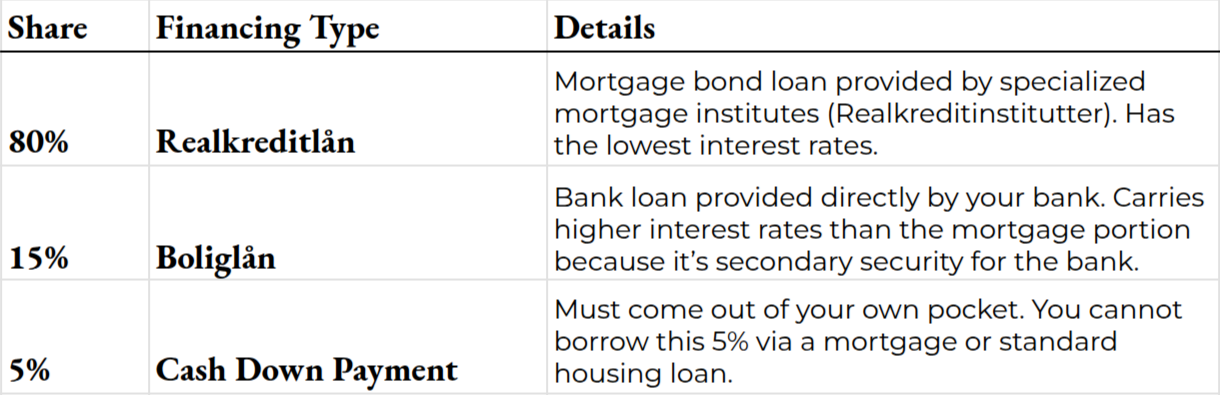
If you’re buying property, you’ll encounter the 80-15-5 rule:
If you’re an expat in Denmark, you also have to:
Have a permanent Danish address (domicile) or
Have lived in Denmark for at least 5 years
If you’re an EU/EEA citizen, you can expect to follow the 80-15-5 rule as stated above.
If you’re from outside the EU/EEA, the downpayment for the property can vary from 10-40% of the purchase price, depending on your bank.
Friværdi (Home Equity): This is the difference between the current market value of your property and the remaining debt on your mortgage. As value on your property goes up or you pay off the principal on your loan, your friværdi grows.
You can use friværdi as collateral in loan negotiations.
Bank loans vs online loans: two sharks enter the ring, but only one gets to eat dinner
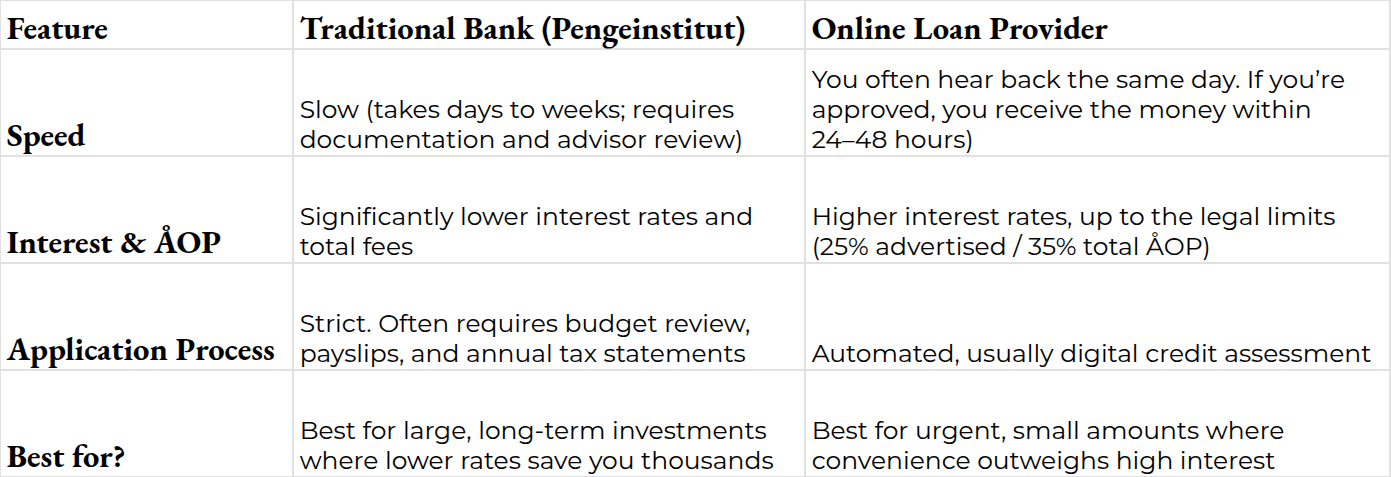
When looking for a personal or consumption loan (also known as forbrugslån), you can choose between a traditional bank or an online loan provider.
Most people would probably advise you to stick with the bank. Not just because the interest is lower, but because there are people there who can speak to you and advise you personally.
However, that doesn’t mean online loans (kviklån, forbrugslån, privatlån and what have you) are inherently bad - as long as you keep in mind that just because they’re quicker and easier to get, doesn’t mean they can’t become a burden.
Inkasso: when your chosen shark stops asking nicely and comes to collect
Alright alright, no more loan sharks.
If you fail to pay your loan installments on time - no matter if it’s with the bank or an online lender - you enter a strict, legally defined recovery process:
Reminder letters (Rykkerbreve): The lender will send up to 3 official reminders. By law, they can charge a fee of up to 100 DKK per reminder, plus reminder interest (morarenter), which is a daily interest that gets added to your loan until you pay.
Notice of Collection (Inkassovarsel): You get a final 10-day notice warning that the debt will be transferred to collection.
Inkasso (Debt Collection): The debt is handed over to either an internal collection department or a third-party debt collection agency. Heavy administration fees are usually added to your balance here, increasing the costs.
Bailiff’s Court (Fogedretten): If you still don’t pay, you risk being summoned to court. The court can order forced sales of your assets (like your car or real estate) or set up a mandatory payment plan.
So, what do you do if you can’t make your payments? My best advice is just to contact your lender. The thing is, this whole process isn’t just expensive for you, it also costs the lender a bunch of money. Lenders - regardless if it’s a bank or an online provider - usually prefer settling things amicably instead of letting the case go to court.
So contact your lender, explain your circumstances and offer alternatives. Maybe you can’t pay the full monthly installment, but maybe you can do 100 kr. a month for the next 5 months? Maybe you can get an extension or a payment break / grace period, where you don’t have to pay for a month or two?
I can’t promise that all lenders are flexible, but I can promise that doing nothing is worse than asking.
RKI: the guest list you really don’t want your name on
What is RKI? RKI (formerly Ribers Kredit Information, now owned by Experian) and Debitor Registret are Denmark's official registers for “bad payers” (dårlige betalere).
These lists keep track of people in Denmark who have outstanding debt. Companies can access these lists to check whether customers are “safe” - usually, banks and lenders will check RKI and/or Debitor Registret as part of their credit check.
How do you get listed? If you ignore debt reminders and collection notices (Inkasso), the lender is likely to register your name in RKI. When this happens, you will be notified in advance and given a chance to react. If you have not been formally notified, any registration of your name is illegal.
You must also be over 18, and the debt must be undisputed.
Consequences of being in RKI:
You cannot take out new loans, mortgages, or credit cards.
You might be denied phone contracts, home internet subscriptions, and lease agreements.
Most Danish banks will restrict your account to a basic debit card with no overdraft buffer.
If you’re applying for permanent residency in Denmark, an RKI-registration is likely to cause your application to be refused.
How to get out of RKI:
Pay the debt: As soon as you settle the balance in full, the lender is legally required to remove you from the register immediately.
Wait 5 years: An entry automatically expires after 5 years for a specific debt. Caution: The debt itself does not disappear, and you can still be sued in court—you just can't be registered indefinitely for that specific unpaid item.
Once removed from the register, there is no history of you there.
Disclaimer: This article is for educational purposes only. Career Club Denmark is not liable for any decisions made based on the contents of this article. For financial advice related to your specific case, please reach out to your bank and/or financial advisor. .
Sources:
General:
https://cphpost.dk/2022-05-16/sponsored/looking-to-take-out-a-loan-in-denmark-and-what-is-a-forbrukslan-everything-you-need-to-know-about-borrowing-money-in-the-country-of-smorrebrod/https://copenhagenexpats.com/glossary/kreditvaerdighed/https://danskebank.dk/en/personal/products/loans/personal-loanshttps://www.remember.dk/artikler/ordliste-forbrugslan/ (danish)https://simpledenmark.com/loan/personal/#:~:text=Personal%20Loan%20Requirements%20for%20Expats%20in%20Denmarkhttps://www.nordea.dk/privat/produkter/laan-og-kreditter/kassekredit.html (danish)
House loans and friværdi:
https://www.creditstar.dk/lan-til-hus-frivaerdi (danish)https://www.lunar.app/en/personal/blog/internationals/how-to-buy-real-property-in-denmarkhttps://www.exploringdenmark.com/mortgage-denmark-foreigner/
Debt collection:
https://www.cosmodca.com/blog/debt-collection-agency-denmark
RKI:
https://lwid.dk/denmarks-rki-register-the-place-you-dont-want-your-name-mentioned/
