
Mentors, Sponsors, and the People Who Say Your Name When You’re Not in the Room
By: Judy Cohen
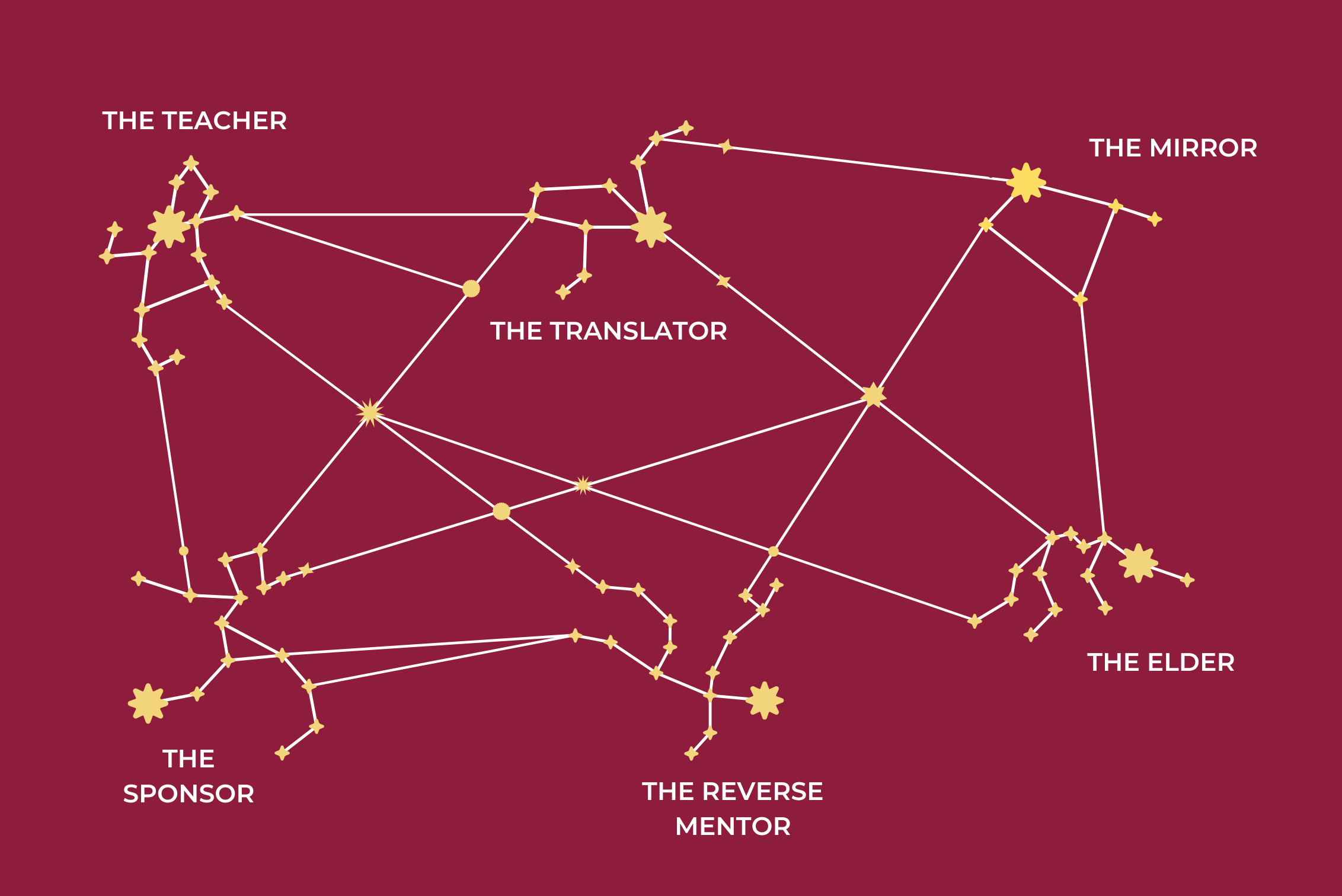
Constellation-style diagram showing mentoring roles: teacher, sponsor, translator, mirror, elder, and reverse mentor.
Most career advice treats mentoring as a single quest.
“Find a mentor.”
As if there’s one wise creature hiding in your org chart, waiting to hand you a laminated plan for your life.
My real version is messier, more human, and way more useful.
It’s a constellation.
The day my mentor taught me ETFs… Against my will
In my early 30s I was trying to understand how to save money.
I was also very good at avoiding anything that smelled even vaguely of “economics.”
One day my work mentor grabbed me for a “meeting.”
I thought it was work.
It was ETFs and index funds. For hours.
He calmly walked me through the basics, drew diagrams, answered my dumb questions, and then said we’d keep doing mini sessions until I understood enough to make decisions.
No formal program. No big speech. Just someone noticing a gap and refusing to let me stay stuck in it.
He's still someone I can call on whenever I need advice, in economics, in life and in not creating the next “Skynet AI” by accident.
If you’ve ever had someone explain the thing you’ve been dodging for years, that’s mentoring in its most practical form.
Mentoring is advice. Sponsorship is advocacy.
Mentoring can change how you think.
But sponsorship changes what happens to you.
A sponsor is the person who says your name in a room you’re not in, and is willing to attach their credibility to it.
It’s rarer because it costs something, political capital, reputation, risk.
Which is exactly why it’s powerful.
A personal example, the professor who didn’t just teach, she positioned people
I had a professor in university who was one of the most respected in her field. Getting into her lab was a big deal.
What made her exceptional wasn’t her knowledge, it was her default behavior.
She pushed her students to the front.
If there was a room where it mattered, she made sure they were the ones speaking. If there was credit to be given, she made sure their names were attached to the work. If there were decision-makers to meet, she introduced her people, early, loudly, and without apology.
Years later, when she moved into tech, she didn’t “start networking.” She already had a network, built out of graduates she’d supported into real roles over time. The trust was already there, because she’d spent years proving she backs people with actions, not compliments.
That’s sponsorship. Not vibes. Leverage.
If you’re reading this and thinking, “I have mentors, but I’m still not getting picked,” this is one place to look.
Stop hunting for one mentor, build a constellation
The “one mentor” idea is comforting, but modern careers rarely work that way.
Instead, think in seasons and in networks.
Once you think in networks, you can stop forcing one person to be everything.
Age is not the point, perspective is
One of my best mentors is about a decade younger than me.
They have brilliant ideas and understand words I genuinely dislike: marketing, click rates, demographics. All the things that make me want to pretend I’m suddenly busy reorganizing a drawer.
They don't mentor me by being older or more senior.
They mentor me by translating a world I would happily ignore… if I didn’t want results.
Sometimes you need experience.
Sometimes you need new eyes.
Sometimes you need someone who speaks fluent “things I hate, but apparently need.”
When I moved to Denmark, my mentors became translators… and occasionally rescuers
When I moved to Denmark, I found mentors in women who had moved here before.
Sometimes it was as simple as someone sitting with me for coffee and explaining a hidden social norm that nobody writes down anywhere.
Sometimes it was a bigger setting, walking around with a group, meeting people, watching how they introduce themselves, learning what “normal” sounds like here.
And sometimes it was someone inviting me to a party when I was completely on my own, willing to take a small social risk on the strange woman who didn’t yet know the rules.
That’s also mentoring. Not career advice, cultural access.
Also, sometimes my social battery was dead.
So the group format was wrong.
I needed one person, one coffee, one honest sentence that saved me six months of guessing.
If you’ve ever moved countries, changed industries, or entered a new work culture, you already know: the translator-mentor is worth their weight in gold.
The roles mentors actually play
Here’s the version that feels true in real life, not as a corporate diagram.
The Teacher: The person who pulls up a spreadsheet and refuses to let you keep guessing.
The Translator: The person who explains why “we should consider” can sometimes mean “no,” depending on the culture.
The Mirror: The peer who tells you, calmly, “You’re underpricing yourself,” or “You’re apologizing too much,” and you actually hear it.
The Elder: Not always older in age, older in calm. Helps you zoom out when you’re trapped in your own urgency.
The Reverse mentor: The younger person who helps you see what the world is becoming, before you fossilize into “the way we’ve always done it.”
The Sponsor: The person who forwards your name before you’ve even heard there’s an opening.
If you have a lot of mentors and zero sponsors, you can still feel weirdly stuck.
It’s not in your head.
CCDK is basically mentoring in multiple formats, and that’s the point
One reason Career Club DK works (at least for me) is that it doesn’t pretend support comes in one shape.
Sometimes you need a group format that makes connection easy, without the weird “networking performance” pressure.
Sometimes you need structure, a 1:1 match where you can go deeper, ask the awkward questions, and actually build something over time.
Sometimes you just need to show up and not do it alone.
And sometimes the most “mentor - like” thing is simply being welcomed into a room, a conversation, a community, especially when you’re new and everything feels slightly… coded.
Different formats for different nervous systems. That’s not fluff, that’s design.
Plot twist, you are probably mentoring others too
Mentoring isn’t only something you get.
It’s something you accidentally become.
If you’ve coached, trained, onboarded, given feedback, helped someone prep for an interview, or simply told a colleague, “No, you’re not crazy, that’s a real issue,” you’ve mentored.
And if you do that regularly, you’re part of someone else’s constellation, whether you call yourself a coach or not. (Trite word, real function.)
The Constellation Check, a 10-minute mentor audit
Open a notes app. Make it messy and fast.
Who helped you grow in the last 2 years? Not official mentors. Real people. Moments count.
What role did they play? Teacher, Translator, Mirror, Elder, Reverse mentor, Sponsor.
What’s missing right now? Common gaps include: lots of advice with no advocacy, lots of group support with no 1:1, seniors only and no peers, career help only and no belonging support… or the opposite.
Make one small ask. Not “will you be my mentor?” Try, “Can I steal 20 minutes to pressure-test a decision?”, “I’m aiming for X roles this quarter, if you see an opportunity where I fit, could you connect me?”, “If something opens up, would you be comfortable putting my name forward?”
That last one is the sponsorship question, said clearly, without begging.
Two questions to end on
Who helped you grow recently, and have you actually told them?
And… Do you need more mentoring right now, or do you need someone willing to bet on you?