
In this edition, we’re demystifying an aspect of hiring that’s often called “corporate horoscopes”: personality tests. Our article looks into their cultural relevance in the job market, exploring the logic behind some of the more popular versions and leaving with a few helpful tips to succeed in the process.
By: Val Khorishko
An estimated 40 to 70% of employers in Denmark use personality tests as part of their recruitment process, so chances are, if you’re looking for a local job, you’ll encounter a behavioral assessment at least once throughout the search process. In this article, we’ll explore personality tests in the context of Danish culture, go over a few of the most popular approaches to behavioral testing, and share some practical tips on how to best handle going through this kind of an assessment.
The case for personality testing
According to Akademikernes AKasse, “A personality test is not a test that you can ‘pass’, but rather a tool for reflection, management assessment and personal development.” While these tests can sometimes be used as filtering tools before the first round of interviews, more often they serve as the layer between the first and the second round of interviews.
While academic research on the prevalence of personality tests in Denmark is difficult to track down, intercultural communication expert from Denmark Kris Roppelt notes that, anecdotally, these kinds of assessments do seem to be used more frequently in Northern Europe versus North America or the Middle East.
Roppelt sees several cultural reasons driving the trend. “Teams in Denmark generally operate with very flat hierarchies, so it is important to assess a candidate’s team fit before the interviews are finished,” — she notes, adding that CBS, for example, teaches psychological testing in organizations to its business students. Additionally, there are substantial costs and challenges associated with hiring and firing, so personality tests turn into an additional layer of security in a competitive market.
“Finally, Denmark places a strong emphasis on personal and professional development,” — concludes Roppelt. “A lot is invested in L&D, and many workshops focus on improving team interaction based on personality tests, so it makes sense to use the tests when someone joins a new team.”
A smörgåsbord of options
While the end goal of different behavioral tests is the same — providing insight into how well the candidate will fit into existing team dynamics and match the personality type expected for the role — there’s lots of variation in the tactical approaches to get there.
DiSC: Used by over a million people across the world every year, this is arguably one of the most popular personality assessments in Denmark. The test, which serves as a tool for exploring your values, is built around four archetypes — dominance, influence, steadiness, conscientiousness — placed along two axes. One ranges from task focus to people focus, the other — from extroverted and proactive to introverted and stability-seeking.
CfL-Personality Focus Profile – 12 Factor (BTB): Originally developed by Danish researchers in the 1980s, the test is meant to assess temperament, drive, approach to problem-solving, and relationship-building skills through an evaluation of 12 personality traits. It is primarily used for recruiting and onboarding knowledge workers in specialist and managerial roles.
TT38: Another assessment created in Denmark and already taken by over 230,000 people, this psychometric test evaluates 34 talents across four dimensions to provide an accurate picture of where the person’s natural strengths lie. It has 440 questions and takes approximately 20 minutes to complete.
The Big6: 205 questions built to evaluate six personality dimensions: extraversion, conscientiousness, openness to new experiences, agreeableness, emotional sensitivity, and self-focus. This test is based on the HEXACO model, Carl G. Jung’s theory of personality typology and Ichak Adizes’ leadership role theory, among others.
The journey from start to finish
There may be no right or wrong answers in personality assessments, but you can still walk into a behavioral test feeling prepared. Doing a run-through of a mock version can demystify the process and get you into the right frame of thinking to put your best — and most authentic — foot forward. For example, you can find a scaled-back version of a TT38 test on Jobindex.dk or try one of the publicly available versions of the DiSC.
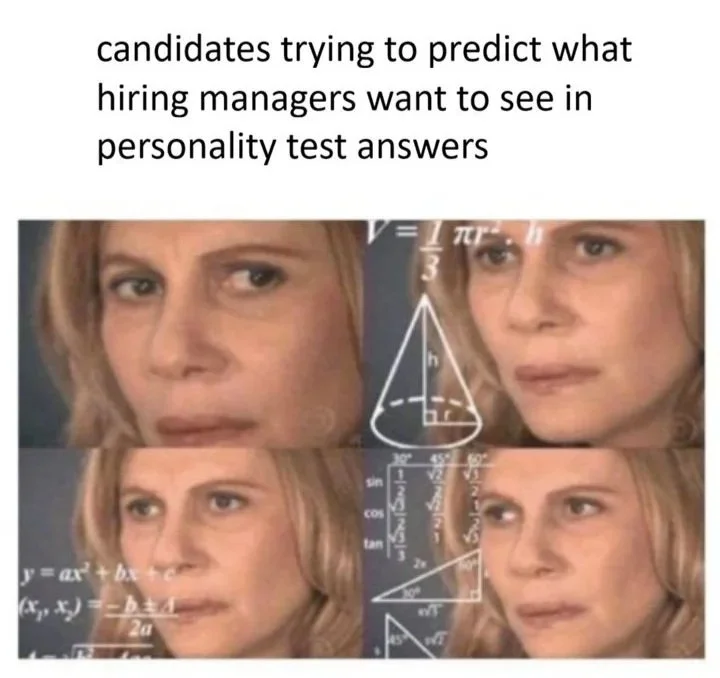
Akademikernes AKasse suggests that being truthful is the ultimate goal in the process. Manipulating your answers to fit what you think the company is looking for can potentially backfire and hurt your chances in the long run. As you answer the questions, think about examples from your personal or professional life to ground your thinking.
And always remember: these assessments are normally used as a starting point for a conversation. If you disagree with the results, you can bring that up at a subsequent interview, with concrete cases backing you up.