
Inclusivity is not just about opening the door. It is also about respecting the limits of the people already inside.
A word everyone likes, until reality shows up.
By: Judy Cohen
I have been thinking a lot lately about what people mean when they say inclusive.
It is one of those words that sounds good immediately. Warm. Generous. Open-hearted. The kind of word nobody really wants to argue with.
And yes, of course, inclusivity matters.
It matters at work. It matters in communities. It matters in who gets heard, who gets welcomed, who gets chosen, who gets forgiven a rough edge, who gets allowed to stay complicated instead of being quietly edited into something smoother.
It matters in who gets to belong without having to earn that belonging through endless adjustment.
So this is not an argument against inclusion.
It is an argument to take it more seriously.
Because somewhere along the way, I think we made the word too flat.
Too shiny. Too simple. Too easy to qualify for.
As if inclusion is always just one thing: open the door wider and let everyone in.
Bring more people in. Make more room. Be more welcoming. Be more open. Say yes more beautifully.
And yes, sometimes that is exactly what is needed.
Sometimes the room is too closed. Too narrow. Too homogeneous. Too comfortable with itself. Sometimes it absolutely needs new people, new voices, new friction, new perspectives.
But not always.
And I think that is the part we struggle to say out loud, especially when we want to sound like good people.
Because inclusion is not only about who gets added.
It is also about what the people already in the room truly have the capacity to handle.
That part matters too.
And not only as an afterthought.
As part of the definition.
Some people pay more just to participate
For some of us, safe spaces are not easy to come by.
Some people move through the world in a way that is considered fairly typical. Their tone makes sense to others. Their energy is easy to read. Their reactions fit what people expect. Their nervous system is not out here freelancing in public.
Others have a different experience.
Some of us spend a surprising amount of time calculating how we are landing.
Too direct? Too intense? Too much? Too fast? Too visible? Too blunt? Too honest? Too enthusiastic? Too clearly not performing normal correctly today?
That takes effort.
And often, a lot more effort than anyone around you realizes.
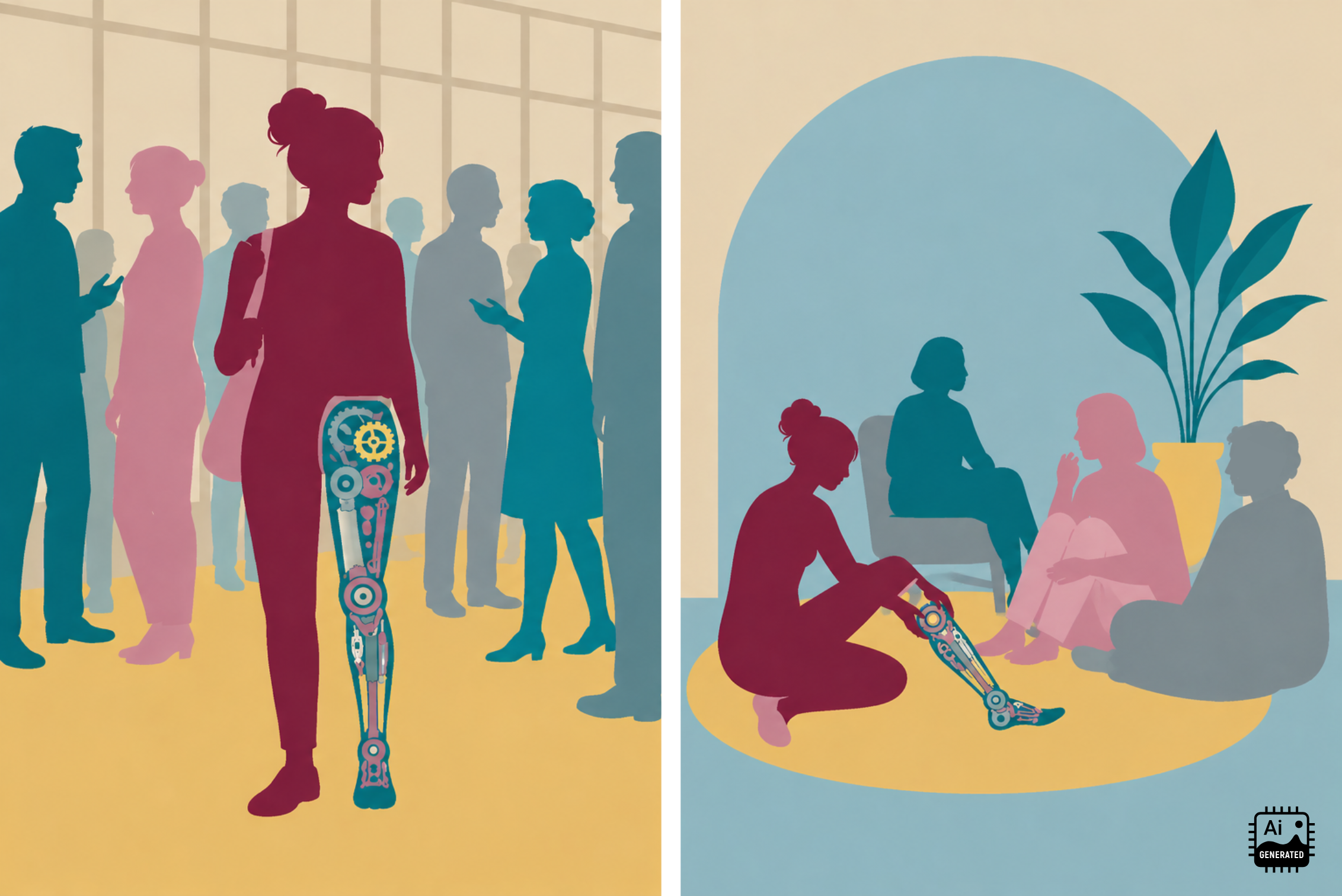
Sometimes I think of it as moving through the world with a prosthetic leg.
Sometimes you can see the limp. Sometimes, or usually, you can’t. Sometimes you hide it well enough that nobody notices.
But it still itches.
It still rubs. It still takes effort. It still changes how you move, whether anyone else sees that or not.
That is the thing about invisible effort.
The better you get at carrying it, the more people assume it weighs nothing.
If someone is still functioning, people assume they are fine. If someone is still showing up, people assume it is manageable. If someone is good at compensating, people assume there is nothing to compensate for.
That is rarely true.
A lot of things that look smooth from the outside are being held together with discipline, pattern recognition, caffeine, dark humour, and one determined inner voice saying, “Not today, Satan, we have a meeting… ”
Masking can look like professionalism. Over-adjusting can look like emotional intelligence. Self-editing can look like maturity. Pushing through can look like resilience.
And yes, sometimes it is resilience.
Sometimes it is simply barely surviving, dressed up with a better vocabulary.
What relief actually feels like
That is why finding a space where you do not have to do quite so much masking can feel almost absurdly precious.
A space where you can let loose. A space where you can be more direct. More natural. More yourself. A space where you do not have to constantly soften, explain, regulate, translate, or pre-edit yourself for other people’s comfort.
Going back to our “Prosthesis leg” metaphor - it's a space where you can simply take it off and no one around you freaks out or even reacts too badly.
That kind of space matters in a way that is hard to explain to people who do not spend all day adjusting their gait.
It is not a luxury.
It is a relief.
It is being able to exhale without immediately wondering if you did it wrong.
It is being able to stop monitoring the room and just exist in it.
It is being able to say the thing in your own words, not the version you ran through internal HR, social risk assessment, and three rounds of emotional proofreading.
And when spaces like that are rare, they matter even more.
Not because they are perfect.
Not because everyone agrees.
But because for a minute, or an hour, or a season, you are not carrying so much invisible translation work.
It changes a person's ability to participate in other aspects of their life.
It changes what trust feels like.
It changes what belonging feels like.
When inclusion becomes pressure
This is where I think the conversation around inclusion often starts drifting.
We talk as if inclusion only moves in one direction, outward.
Open the door wider. Invite more people in. Be more welcoming. Be more flexible. Be more open.
Fine. But then what?
What happens after the door opens?
Do the people already inside the space still feel safe enough to stay fully themselves?
Do they feel heard when they name a limit?
Do they get to share a boundary without that boundary being mistaken for negativity, unwillingness, or lack of openness?
Because that translation happens more often than we admit.
A practical concern becomes a moral one. A bandwidth issue becomes a mindset issue. A boundary becomes a character issue. A request for accommodation becomes a lesson in openness.
And once that happens, the original concern starts disappearing under the weight of nicer language.
That is where inclusion becomes pressure.
Not loud pressure, usually.
Soft pressure. Polite pressure. Positive pressure. Pressure with excellent vocabulary.
The kind that sounds lovely and still leaves someone feeling wrong for having a limit.
I also think we confuse warmth with understanding.
They are not the same thing.
Something can sound kind, polished, thoughtful, generous, and still completely miss the reality of what someone is trying to say.
A response can be full of appreciation and still be dismissive in substance.
That is not always kindness.
Sometimes it is just pressure in softer clothes.
Not every boundary is exclusion
This part matters enough to say plainly.
Not every no is exclusion.
Not every hesitation is closed-mindedness.
Not every limit means someone is unwelcoming, difficult, rigid, or selfish.
Sometimes a no is honesty.
Sometimes a boundary is what keeps a space humane.
Sometimes saying “not like this” or “not right now” is the most responsible thing a person can do.
I think we have become so attached to the language of openness that we sometimes treat any friction as moral failure.
But boundaries are not hostility.
Capacity is not cruelty.
Being realistic is not the same as being unkind.
And pretending otherwise does not make a space more inclusive. It just makes it harder for people to be their true selves in it.
That is not a small problem.
Because once honesty becomes socially risky to express, people stop providing it.
Then they either over-accommodate until they burn out, or quietly withdraw while smiling.
Neither is especially healthy.
Maybe the real question should not only be, who is missing from the room, but what it costs the people already inside to stay there fully as themselves.
What inclusivity means to me
To me, inclusivity is not about making a space look open from the outside.
It is not about optics. It is not about numbers. It is not about collecting the right kind of diversity and calling it a day.
It is about whether the people inside the setup feel heard.
Whether boundaries can be named without being blurred out. Whether limitations are treated as real, not as inconvenient. Whether people are allowed to tell the truth about what they can carry. Whether the room works not only for the easiest bodies, minds, and personalities in it, or also for the more uneven, complicated, visible, tired, overstimulated, sharp-edged humans too.
Because inclusivity is not just about opening the door.
It is also about respecting the limits of the people already inside.
That is not resistance to inclusion.
That is part of inclusion.
And for some of us, being able to exist somewhere without constantly adjusting our gait for the comfort of the room is not a small thing.
It is everything.