
The Cost of Being Both Competent and Female - Staying Whole Inside Masculine Systems
By: Judy Cohen
Let’s start with something annoying and relatable.
The pink tax.
You walk into a store, you need a razor, you pick one up, it’s blue, it’s called “Sport Warrior 9000,” it costs 49 DKK.
Next to it is the same razor.
Same shape.
Same blades.
Same everything.
But it’s pastel, and it’s called “Silky Goddess Whisper,” and it costs 79 DKK.
And your brain does this little pause.
Wait… what?
That pause is the point.
Not the outrage. Not the capitalism rant. Just the moment you notice a pattern and realise you’ve been paying extra for no functional reason. Just for color. For marketing.
And once you see it, you stop being the easiest customer in the aisle.
You don’t argue with the shelf. You don’t take it personally. You just buy the cheaper one and go home.
Work has the same thing.
Not in money, usually… in effort.
And if you don’t know the pattern exists, you end up overpaying.
This is not another “work wasn’t built for women” article
Yes, it wasn’t. We know. We can all go home now.
Complaining about it shouldn't be the focus. Literacy should be.
And to be clear, this isn't about men. Plenty of them get crushed by these same norms, especially the thoughtful, collaborative, emotionally intelligent ones who aren’t built for constant dominance games. This is about defaults and incentives, and how to stop overpaying because of them.
Because the real problem isn’t the system existing. Systems exist. Every workplace is a system.
The real problem is what happens when you think the friction is a character flaw, and you start trying to “fix yourself” into a shape that was never yours.
That internal spiral is familiar to most of us:
Maybe I’m not confident enough.
Maybe I’m too emotional.
Maybe I need to be tougher.
Maybe I should stop smiling.
Maybe I should talk lower.
Maybe I should be more direct… but not too direct… but also not too soft… but also not too cold…
And suddenly you’re not working anymore, you’re doing constant self-editing, while also trying to do your actual job.
It’s exhausting.
So here’s the shift I care about:
When you stop taking it personally, you can start working with it professionally. Not in a shady way. In a practical way. Because you can’t change what you can’t name, and you can’t navigate what you refuse to see.
System literacy, what it actually mean?
It means you stop saying “I’m bad at this” and start saying something far more useful:
“Ah. This environment prefers a specific currency, and I haven't converted my value into it/that one yet.”
It’s annoying, yes. It’s also freeing.
Because once you understand what the system rewards, you unlock various options.
You can choose what to translate. What to make visible. What you refuse to overpay for. You get to stay yourself… you just stop getting misread.
The worst advice is “Just perform like a man”
Sometimes it’s said politely.
“Be more assertive.”
“Take up more space.”
“Don’t soften your language.”
“Stop apologizing.”
“Be decisive.”
“Own the room.”
And yes, some of that can be useful.
But what often happens is people start thinking success requires a personality transplant, so they harden in ways that don’t even feel like strength, it just feels like armour.
They cut warmth. They cut curiosity. They cut humor. They cut softness. They cut the exact things that make them good at what they do, and then they get the promotion and feel… weird.
Like they won, but they lost themselves a little.
So no. The move is not “become masculine.”
The move is “become literate.”
Same way you don’t need to become a razor company to avoid the pink tax, you just need to notice how the shelf works.
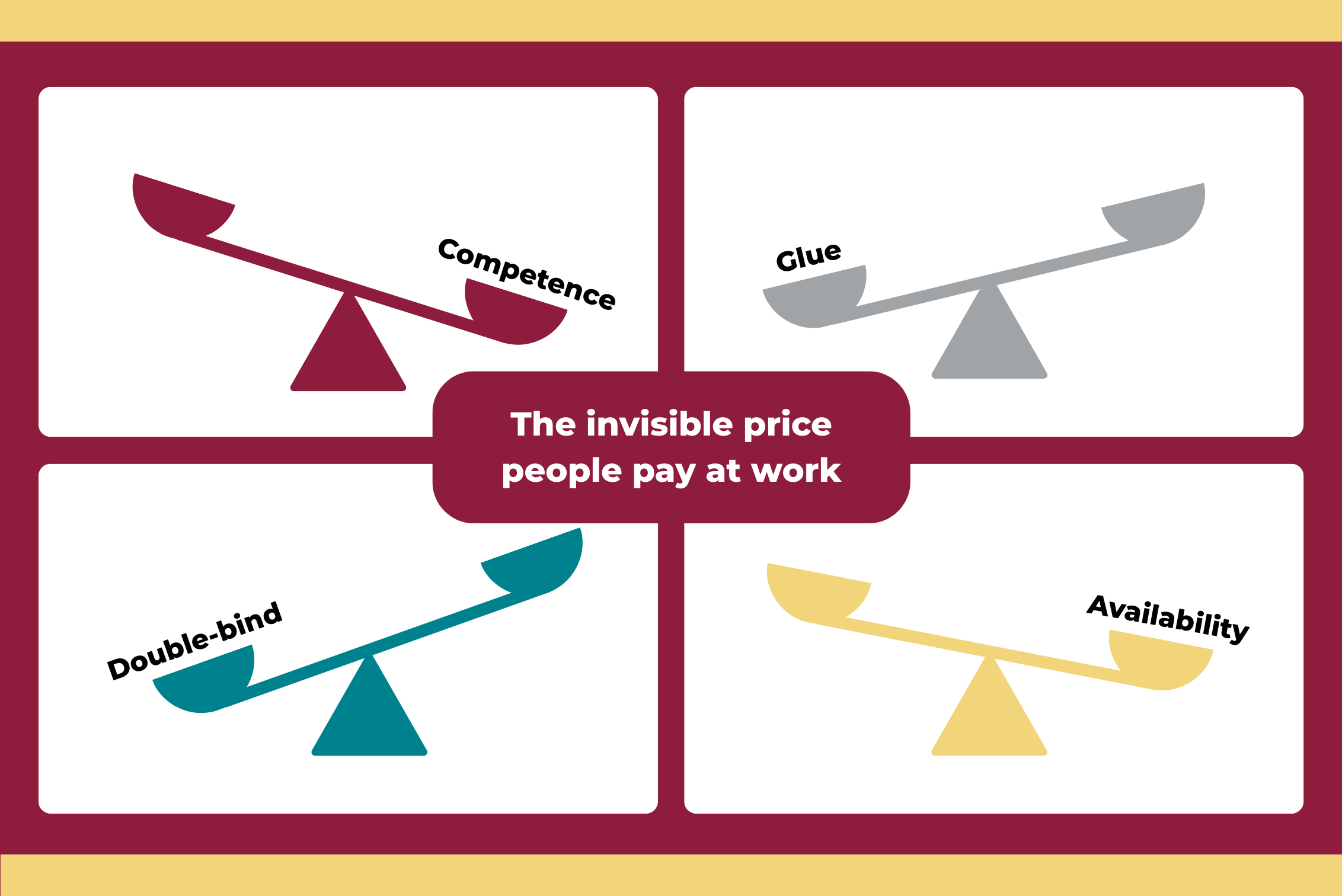
The invisible price people pay at work
Let’s name a few “taxes.” Again, not always money. Mostly energy.
And it’s sneaky because it doesn’t show up as “THIS IS A TAX.” It shows up as your Thursday afternoon mood, where you’re strangely tired and can’t even explain why.
The competence tax
You can feel it, that tiny extra layer of having to prove yourself and your worth. The follow-up questions that aren’t really questions, more like “Are we sure you know what you’re doing?” Meanwhile your colleague once put “Excel” on his CV because he opened it in 2013, and nobody asks him for a thesis.
Cost: extra prep, extra justification, extra performance.
The glue tax
You become the person who remembers everything, smooths everything, fixes everything, explains everything, makes everyone feel okay, and then you get called “supportive.”
Supportive is lovely. Supportive is also… not always promotable.
Cost: you end up carrying the team while someone else gets credited for “strategy.”
The double-bind tax
If you’re warm, you’re not serious. If you’re direct, you’re difficult. If you’re confident, you’re too much. If you’re careful, you’re not leadership material. So you start rewriting your own emails as if you’re negotiating with an invisible jury.
Cost: constant tone management and self-monitoring.
The availability tax
Because you’re capable, people treat your capacity as communal property. Your calendar becomes a suggestion, and somehow you’re always the backup plan.
Cost: burnout dressed up as “being helpful.”
None of these are “men things.” They’re just behaviours and signals many workplaces learned to use as currency over time. And yes, they punish plenty of men too, especially the ones who lead with collaboration, depth, and care.
Once you can name these patterns, you can decide how you move around them.
Okay, so what do we do, practically?
Not a 12-step program. Not a girlboss manifesto. Just a few moves that tend to help, and you can adopt any of them.
1) Stop donating invisible labor (and make the work visible)
If you’re the person who always picks up the extra slack, the notes, the “I’ll just handle it,” the onboarding, the emotional cleanup… you’re not alone. I used to do this constantly, partly because I could see what needed doing, partly because I was fast, and partly because being competent is basically a magnet for “Can you just…?”
The problem wasn’t that I was doing too much work.
The problem was that the work didn’t exist anywhere except in my head and in my habit of catching things before they broke, so to everyone else it looked like… nothing. Like I had “capacity.” Like I was just naturally supportive.
So I did something painfully unglamorous that worked.
I created a task list, literally a simple Excel file, and I forced the extra work to become visible. Everything went in: what it was, who owned it, what the deadline was, what it depended on, and what mattered most.
And then I stopped picking things up silently.
I started using one sentence on repeat:
“Sure, happy to take it. What should I deprioritise to make room?”
That sentence isn’t aggressive. It’s just reality.
It forces the system to admit time is finite, and it turns “helpfulness” into prioritisation.
If they pick something, great, now your work has a shape and visibility to it.
If they pick nothing, you learn something important about the culture… and you have a choice.
2) If you speak in context, start with the point
This is the most common thing I see with smart people.
They think out loud. They build the logic. They set the scene. They’re being thoughtful. And then someone interrupts with a half-formed opinion said confidently, and the room goes, “Great point,” as if your full brain didn’t just speak for three minutes.
So do this instead:
Start with the headline, then give the context.
“My recommendation is X… because the risk is Y… what I need is Z.”
Then you add nuance.
You’re not dumbing yourself down. You’re making sure your point lands before it gets swallowed by the room’s default speed.
3) Align earlier, so you don’t spend the meeting “selling” your idea
This one is simple, remove the element of surprise.
If you know a decision is coming, talk to the key people beforehand. Ten minutes. Two messages.
“Hey, I’m thinking of proposing X tomorrow, any concerns I should address?”
“If I raise this, would you support it?”
That’s it.
It’s not manipulation. It’s how humans work. Most people don’t like being surprised in public, and many organisations are more social than they admit.
4) Keep your warmth, but stop letting it be interpreted as free access
Warmth is not a weakness.
I will repeat this: Warmth is NOT a weakness.
Warmth without boundaries is expensive.
If you’re warm and helpful, people will take advantage.
Sometimes they don’t even notice they’re doing it.
Sometimes they do.
Either way, you’re the one paying for it. In time, in energy, in focus.
So instead of forcing yourself to say no and feeling harsh about it…
Try saying, “You choose.”
It shifts the responsibility back where it belongs.
“I can do A or B this week, which one matters more?”
“That’s outside scope, do we want to redefine the scope?”
“I’m not the right owner for that, but I can suggest who might be.”
You’re allowed to be kind, yet always be clear.
5) Mentors are nice, sponsors are oxygen
\Mentors give advice. Sponsors do something riskier.
Sponsors say your name in rooms you’re not in. They put you forward. They vouch on behalf of you. They spend capital.
So instead of collecting a hundred supportive chats, ask for one real action:
“Would you put my name forward for X?”
“Can you back me when this comes up?”
“Can you introduce me to the decision-maker?”
This is uncomfortable for most women, not because it’s wrong, but because we’ve been trained to be grateful, not strategic.
The femininity part, because yes, it matters
I hate how this topic always becomes “So you want women to be softer?”
No.
Femininity is not softness. It’s range.
It’s intuition. Pattern recognition. Emotional accuracy. Relational intelligence. Depth. Humor. Human radar.
Staying feminine, in the way I perceive it, means you don’t amputate those abilities to be taken seriously. You don’t become colder in order to gain respect.
You become more direct. You become more literate. You stay whole.
The point (again, because this is the whole thing)
This is not a critique piece, but an exercise in literacy.
Because once you identify the system, you can choose to avoid paying invisible taxes.
You stop blaming yourself for friction that isn’t personal.
You showcase your value so it can be understood.
You choose what you adopt… and what you refuse to.
You learn the rules without letting the rules rewrite you.
And weirdly… that’s when you start winning.
Not by turning into someone else.
As yourself.
A tiny exercise - five minutes.
Where are you overpaying for at work right now?
Not emotionally. Literally.
Where are you giving extra time, extra effort into managing your tone, extra proving, extra smoothing, extra explaining… just to be treated as baseline competent?
Write down one place you’re donating labor.
Then pick one move:
Ask “what should I deprioritise?” once this week.
Start with the headline once.
Align one conversation earlier.
Make one boundary visible.
Ask for one sponsorship action.
Do one thing. Repeat it.
That’s how you stop paying the tax.